Many overseas brands find a "factory" through B2B platforms or Google, only to discover after ordering that the other side is a middleman: the price carries an extra layer and so does the communication. Lumepacking is a custom paper packaging supplier with its own factory. This article explains 6 ways to judge whether the other side is a source factory.
Verifying a source packaging factory: key points
- The 3 most reliable methods: the business scope on the business licence, a video tour of the workshop, and details of processes and equipment.
- 2 unreliable indicators: registered capital, and whether the registered address matches the office address.
- The Lumepacking factory: Yiwu, Zhejiang; 1,200 square metres of floor space; 32 employees; equipment includes printing presses, creasing machines, laminating machines and automatic box gluing machines.
Source factory vs middleman (trading company)
| Comparison | Source factory | Middleman (trading company) |
|---|---|---|
| Price | No middle markup | Usually a markup |
| Communication | Direct contact with production | Has to be relayed to the factory |
| Product range | Focused on a few categories | Very wide range of categories |
| MOQ | Usually higher | May be lower |
| Handling problems | Adjusts production directly | Has to coordinate with the factory |
A middleman is not necessarily bad. If you need to buy several categories at once, or need someone to manage several factories for you, a good trading company also has value. The key is to know who you are working with.
How to find a source packaging factory: 6 ways to verify
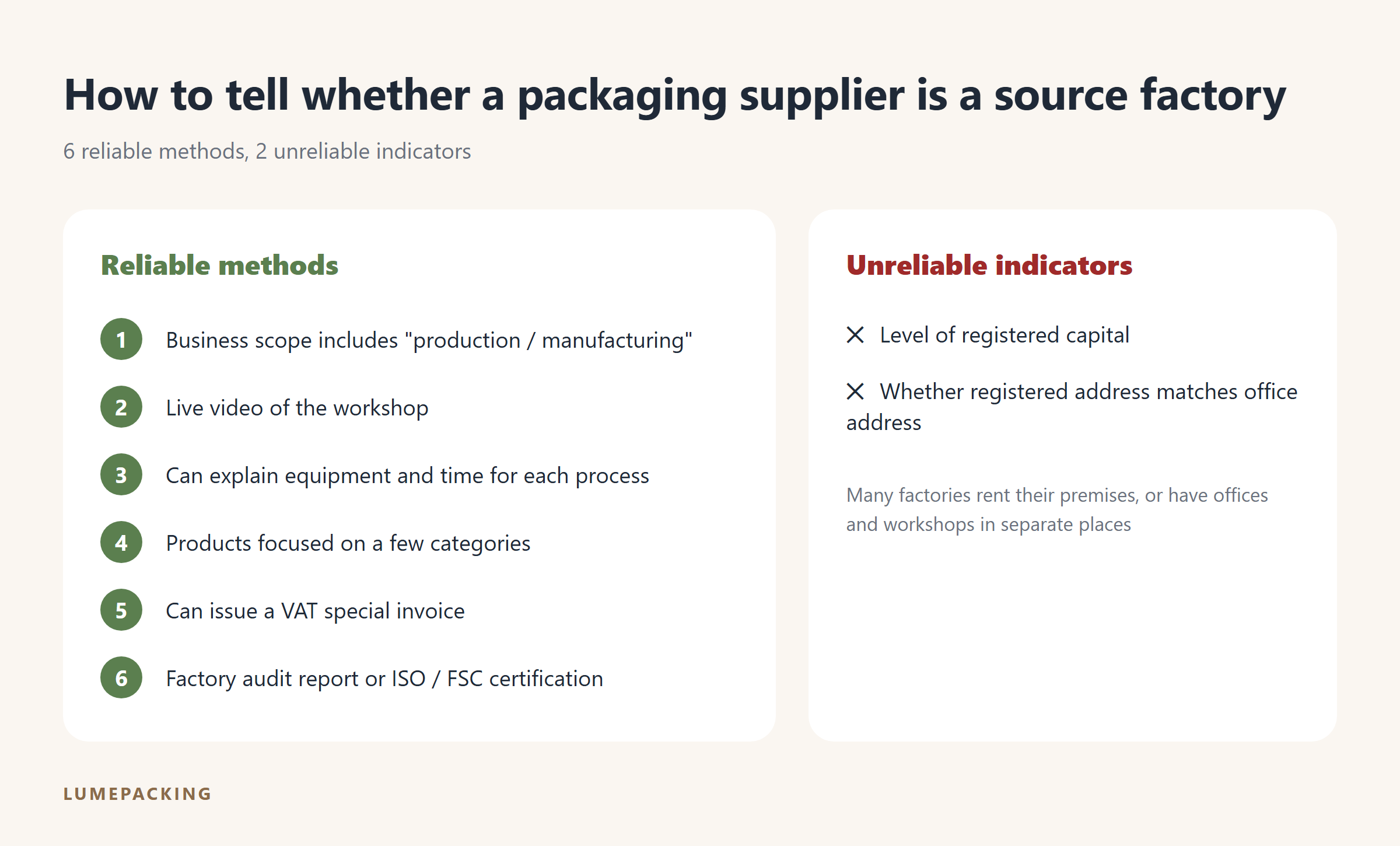 6 reliable ways and 2 unreliable indicators for judging whether a packaging supplier is a source factory
1. Check the business scope on the business licence
Ask for the business licence. A factory's business scope usually includes production-type descriptions such as "printing of packaging and decorative printed matter" or "paper product manufacturing"; a trading company usually has only "sales" or "import and export".
A printing enterprise also needs a printing business permit.
2. Tour the production workshop by live video
Ask for a live video, not a pre-recorded one. Ask them to show on the spot: the printing press, the die-cutting machine, the box gluing machine and an order that is currently in production.
3. Ask about processes and equipment
A source factory can answer these questions immediately:
- Which printing press do you use, and how many colours?
- Are die cutting and box gluing automatic or manual?
- How many days does each process take?
- Where is the paper purchased from?
A middleman usually has to "ask the factory" before answering.
4. Look at the product range
A factory usually concentrates on a few categories, such as paper boxes, paper bags and gift boxes. If a supplier sells packaging, clothing and electronics at the same time, it is very likely a trading company.
5. Ask for a VAT special invoice
A factory in China can issue a VAT special invoice, and the company name on the invoice matches the business licence. This method suits buyers who have a purchasing team or agent in China.
6. Ask for a factory audit report or system certification
For example a third-party factory audit report, ISO 9001 or FSC certification. Check that the company name on the report matches the business licence.
Two unreliable ways to judge
- Registered capital: the amount of registered capital has no direct connection with whether there is a factory.
- Whether the addresses match: many factories rent their premises, or have offices and workshops in separate places, so a mismatch in addresses does not mean it is a middleman.
How to get started
If you want to confirm Lumepacking's production capacity, you can book a video factory tour. We will show you the printing press, creasing machine, laminating machine, automatic box gluing machine and the orders in production on the spot, and explain which processes and how much time your packaging needs.